Capital gains tax Malta: property pays 8% of the sale price, not the profit
Capital gains tax in Malta takes two forms. A property sale pays a final tax of 8% on the transfer value under article 5A of the Income Tax Act, whatever the profit, and gains on unlisted shares and business assets join your income at the article 56 rates of 0% to 35%. Listed shares are exempt under article 5(6), and crypto held as an investment is not taxed.
Work out the tax on a property sale, an unlisted shareholding or a crypto disposal from your dates and costs. Enter sales by hand or import your exchange CSVs, and the calculator splits multi-parcel sales under FIFO, picks the property rate from your purchase date and how you acquired it, applies the own-residence test, nets your article 5(10) losses and shows the arithmetic behind the final figure. Everything stays in your browser.
Rates current as of 2026-09-19, from the Income Tax Act, Cap. 123 and the sources each record cites.
Property
Malta property tax: a final tax on the transfer value
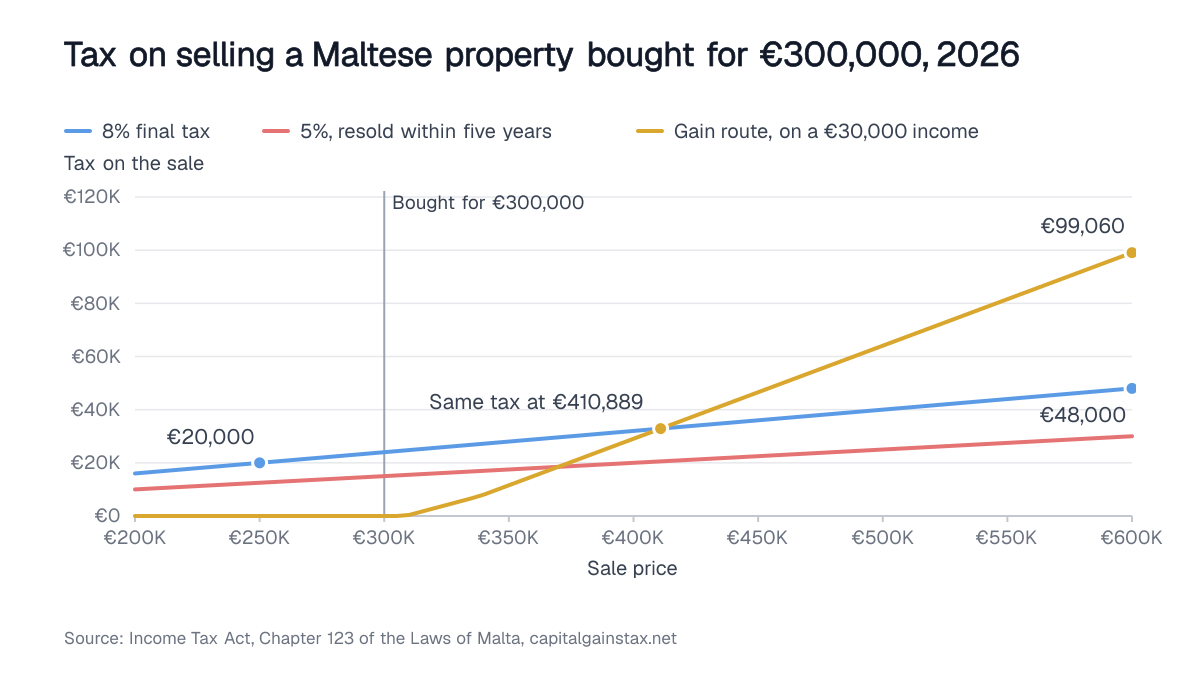
Selling property in Malta does not produce a tax bill on your profit. Article 5A(5) of the Income Tax Act charges a final tax on the transfer value, which article 5A(6)(a) defines as the price in the deed or the market value, whichever is higher. For transfers since 1 January 2015 the ordinary rate is 8%, set by the second proviso to article 5A(5)(a). Article 5A(9) allows no deduction from the transfer value, so the purchase price, the notary's fees and the agent's commission do not reduce the tax, and a sale at a loss pays the same rate as a sale at a profit.
The rate depends on how and when you acquired the property:
- Sold within 5 years of buying it, where the property is not part of a project: 5% of the transfer value (article 5A(5)(e)).
- Acquired before 1 January 2004: 10% of the transfer value (article 5A(5)(f)).
- Inherited after 24 November 1992, or received as a donation more than 5 years before the sale: 12% of the transfer value less the acquisition value, so this is the one rate charged on the gain (article 5A(5)(b)).
- Inherited before 25 November 1992, or sold by judicial auction: 7% of the transfer value (article 5A(5)(c)).
- Bought as your sole ordinary residence, declared as such in the purchase deed, and sold within 3 years while you own no other residential property: 2% of the transfer value (article 5A(5)(g)).
In the example the flat makes the same €120,000 profit whichever year it sells. Sold 4 years after purchase, the 5% rate takes €21,000, 17.5% of the profit. Sold 6 years after purchase, the 8% rate takes €33,600, 28% of the profit. Waiting past the 5-year mark raises the tax, because the lower rate rewards a quick resale.
Rates used: 5% from article 5A(5)(e) and 8% from the second proviso to article 5A(5)(a) of the Income Tax Act.
Example: a flat bought for €300,000 and sold for €420,000 in 2026
| Step | Amount |
|---|---|
| Purchase price | €300,000 |
| Transfer value (the sale price) | €420,000 |
| Profit | €120,000 |
| Tax if sold 4 years after purchase (5%) | €21,000 |
| Tax if sold 6 years after purchase (8%) | €33,600 |
Show the code
Copy this code into your page. The chart and the credit both link to this page.
Your home
Selling your own home in Malta: the 3-year residence exemption
The sale of your own home pays no final tax when you owned and lived in it as your only or main residence for at least 3 consecutive years immediately before the sale, and you sell within 12 months of moving out (article 5A(4)(c)). The home must not be part of a project, and you declare it as your main residence by an election to the Commissioner. Article 5(5)(b) gives the same exemption from tax on the gain.
The years can come from someone else. Time a parent or grandparent owned and lived in a home you inherited from them counts as your own, and so does a spouse's time when you inherit the home from your spouse. Since Act IX of 2025, when a couple who lived in the home for 3 years separate or divorce and one of them moves out, the home counts as vacated only when the other spouse moves out too (article 5A(4)(c)(vii)).
The 12-month window is where the exemption is lost. In the example the owner who sells 10 months after moving out pays €0. The same sale 14 months after moving out pays the ordinary 8% on the whole transfer value, €30,400, although the home was the owner's residence for 9 years.
Rules used: the exemption in article 5A(4)(c) and the 8% rate in the second proviso to article 5A(5)(a) of the Income Tax Act.
Example: a home bought for €210,000, lived in for 9 years and sold for €380,000 in 2026
| Step | Amount |
|---|---|
| Purchase price | €210,000 |
| Transfer value (the sale price) | €380,000 |
| Profit | €170,000 |
| Tax if sold 10 months after moving out | €0 |
| Tax if sold 14 months after moving out (8%) | €30,400 |
Shares
Capital gains tax on shares in Malta: listed shares are exempt
Article 5(6) of the Income Tax Act exempts the transfer of shares listed on a stock exchange the Commissioner recognises, and of listed fund units held in a prescribed fund. The exemption depends on the listing and nothing else. A listed share sold a week after you bought it is as exempt as one held for twenty years.
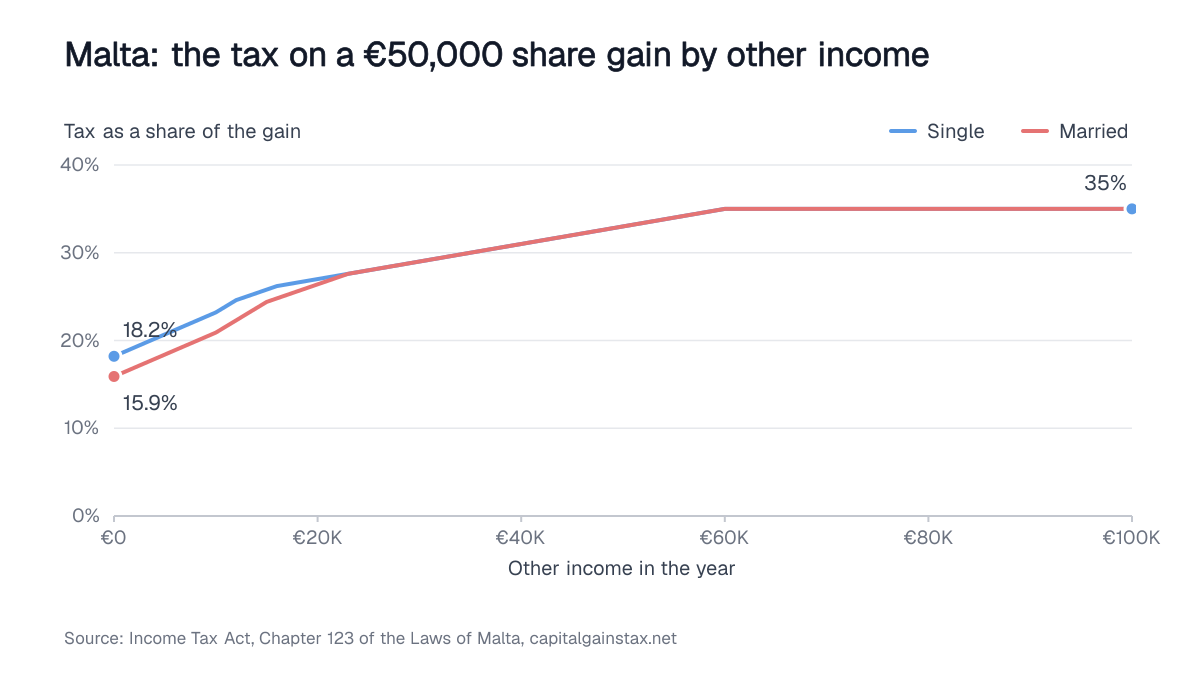
Unlisted shares, a stake in a private company, business assets, goodwill and intellectual property are capital assets under article 5(1)(a), and there is no separate capital gains rate for them. The gain is added to your chargeable income for the year and taxed at the article 56 rates of 0%, 15%, 25% and 35%, so the same gain costs more on a higher income.
In the example a single person with €35,000 of other income sells shares at a €40,000 gain. On listed shares the tax is €0. On unlisted shares the gain lifts chargeable income to €75,000, past the €60,000 start of the 35% band, and the tax on the gain is €11,500.
Rates used: the 2026 single schedule in article 56(1)(b), and the exemption in article 5(6)(b) of the Income Tax Act.
Example: shares bought for €60,000 and sold for €100,000 in 2026, single, €35,000 of other income
| Step | Amount |
|---|---|
| Purchase price | €60,000 |
| Sale price | €100,000 |
| Gain | €40,000 |
| Tax if the shares are listed | €0 |
| Tax if the shares are unlisted | €11,500 |
Show the code
Copy this code into your page. The chart and the credit both link to this page.
Crypto and foreign assets
Crypto and gains made abroad
Crypto is not one of the assets article 5(1)(a) lists, so a gain on coins you hold as an investment is not a taxable capital gain. Crypto you deal in as a trade or business is business income under article 4(1)(a), added to chargeable income at the article 56 rates. The calculator taxes a crypto sale only when you mark it as trading.
Proviso (ii) to article 4(1) takes capital gains arising outside Malta out of tax for a resident who is not domiciled in Malta or not ordinarily resident there. Tick that status in the calculator and foreign assets drop out of the year.
Traps
The rules that catch sellers out
Five rules decide more Maltese tax bills than the rates do.
- A low declared price does not lower the tax. The transfer value is the market value whenever that is higher (article 5A(6)(a)), and if the deed declares less than 85% of market value, the Commissioner can order the extra tax within 12 months of being notified of the transfer (article 5A(12)(d)).
- Building work can cost you the 5% rate. Article 5A(5)(e) does not apply if you or a related person carried out works needing development permission on the property in the 5 years before the sale, unless you bought it as your sole ordinary residence and said so in the purchase deed (article 5A(5)(e)).
- Property forming part of a project gets neither the 5% resale rate nor the own-home exemption.
- A loss on a property sale taxed under article 5A cannot be set against any income or gain (article 5A(9)(b)).
- A loss on unlisted shares or other article 5 assets reduces only capital gains in later years, never your salary, and it carries forward until it is used up (article 5(10)).
Changes
What changed in Malta's capital gains rules, 2021 to 2027
The property rates have held since the 2015 reform. The second proviso to article 5A(5)(a) set 8% of the transfer value for transfers from 1 January 2015, and every year from 2021 to 2027 carries the same 8% ordinary rate, 5% resale rate, 10% pre-2004 rate and 12% rate on inherited property.
The income bands that tax unlisted shares and other article 5 gains widened from the 2025 basis year (article 56(1)): the single 0% band rose from €9,100 to €12,000, the married band from €12,700 to €15,000 and the parent band from €10,500 to €13,000. The 35% rate still starts at €60,000.
Act IX of 2025 added the separation rule to the own-home exemption: after a divorce or separation, the home counts as vacated only when both spouses have left it (article 5A(4)(c)(vii)).
Filing and paying
How the property tax is paid, and when to file
The notary who publishes the deed collects the final tax and remits it to the Commissioner within 15 working days of the transfer, by bank draft or a cheque drawn on the notary's own account (article 5A(11)). Both parties must declare to the notary every fact that sets the rate or an exemption, and the market value where it is above the price (article 5A(12)(a)). The tax is final and separate from income tax, and no provisional tax is due on the sale (article 5A(10)(a)), so a property sale taxed this way does not go into your income tax computation.
Gains on unlisted shares and other article 5 assets go into your annual income tax return and self-assessment. The return for 2026 is due by 30 June 2027, with any tax still owed. For the 2025 basis year the Malta Tax and Customs Administration moved the 30 June date for filing and payment to 31 July 2026.
Income Tax Act, Cap. 123
Malta property transfer tax and income tax rates
Final withholding on property and the article 56 income rates, 2021 to 2027
| Tax year | Property transfer | Resold within 5 years | Pre-2004 acquisition | Inherited or donated | Single rates |
|---|---|---|---|---|---|
| 2021 | 8% of the transfer value | 5% | 10% | 12% of the excess | 0% to €9,100, then 15%, 25%, 35% |
| 2022 | 8% of the transfer value | 5% | 10% | 12% of the excess | 0% to €9,100, then 15%, 25%, 35% |
| 2023 | 8% of the transfer value | 5% | 10% | 12% of the excess | 0% to €9,100, then 15%, 25%, 35% |
| 2024 | 8% of the transfer value | 5% | 10% | 12% of the excess | 0% to €9,100, then 15%, 25%, 35% |
| 2025 | 8% of the transfer value | 5% | 10% | 12% of the excess | 0% to €12,000, then 15%, 25%, 35% |
| 2026 | 8% of the transfer value | 5% | 10% | 12% of the excess | 0% to €12,000, then 15%, 25%, 35% |
| 2027 (planning) | 8% of the transfer value | 5% | 10% | 12% of the excess | 0% to €12,000, then 15%, 25%, 35% |
Property rates, exemptions and loss rules
| Rule | Value |
|---|---|
| Property transfer, ordinary rate (article 5A(5)(a)) | 8% of the transfer value, final and separate from income tax |
| Non-project property resold within five years (5A(5)(e)) | 5% of the transfer value |
| Property acquired before 1 January 2004 (5A(5)(f)) | 10% of the transfer value |
| Property inherited after 24 November 1992 or donated more than five years before (5A(5)(b)) | 12% of the excess of the transfer value over the acquisition value |
| Property inherited before 25 November 1992, or sold by judicial auction (5A(5)(c)) | 7% of the transfer value |
| Transfer value (5A(6)(a)) | The higher of the market value and the consideration, with no deduction (5A(9)(a)) |
| Own residence, articles 5(5)(b) and 5A(4)(c) | Exempt when owned and occupied for three years immediately before the transfer and disposed of within twelve months of vacating |
| Unlisted shares, stakes, business assets, intellectual property, partnership interests | Added to chargeable income at the article 56 rates, 0% to 35% |
| Shares listed on a recognised exchange, and prescribed-fund securities (article 5(6)) | Exempt |
| Crypto held as an investment | Not one of the article 5(1)(a) categories, so not taxed |
| Assignment of a promise of sale | A 15% flat tax on the assignment; not modelled by this calculator |
| Property vacant seven years or more, or in an Urban Conservation Area | Exempt on the first EUR 750,000 of the transfer value, for transfers made by 31 December 2026 |
| Losses (article 5(10)(b)) | Set against later capital gains only, with no time limit, never against other income |
| Foreign gains for a resident who is not domiciled or not ordinarily resident | Not taxed (proviso to article 4(1)(g)) |
Tables are rendered from the source records as of 2026-09-19. Property figures follow article 5A of the Income Tax Act; the article 56 income schedules come from the Malta Tax and Customs Administration rate tables.
Property, shares, crypto
Capital gains tax in Malta: questions sellers ask
What is the capital gains tax rate in Malta?
Property and other gains are taxed differently. A property sale pays a final 8% of the transfer value, or 5% if you sell within 5 years of buying, with other rates for property acquired before 1 January 2004 or inherited. Gains on unlisted shares and business assets are added to your income and taxed at 0%, 15%, 25% and 35%. Listed shares are exempt.
Is there capital gains tax on shares in Malta?
Not on shares listed on a recognised stock exchange: article 5(6) exempts them whatever the holding period. Unlisted shares are taxed. In the example above a €40,000 gain on €35,000 of other income costs €11,500 on unlisted shares and €0 on listed ones.
How is property tax calculated when you sell in Malta?
Multiply the transfer value, the deed price or the market value if higher, by the rate for your case. A flat sold for €420,000 pays €33,600 at 8%, or €21,000 at 5% if sold within 5 years of purchase. No costs are deducted and the profit plays no part.
Do you pay tax when you sell your home in Malta?
No, if you owned and lived in it as your main residence for at least 3 consecutive years right before the sale and you sell within 12 months of moving out. Miss the window and the full 8% applies: €30,400 on a €380,000 sale in the example above.
What is the tax on property sold within five years in Malta?
5% of the transfer value, where the property is not part of a project and no works needing development permission were carried out in the 5 years before the sale. Otherwise the ordinary 8% applies.
Does Malta tax crypto gains?
Not when you hold crypto as an investment, because crypto is not one of the capital assets article 5(1)(a) lists. Trading crypto as a business is business income taxed at the article 56 rates.
Who pays Malta's property transfer tax, and when?
The seller owes it and the notary pays it to the Commissioner within 15 working days of the deed. It is final, so it does not go on your income tax return.
Can a capital loss reduce tax in Malta?
Only an article 5 loss, such as a loss on unlisted shares, and only against capital gains in later years. It never reduces other income. A loss on a property sale under the final tax is not deductible at all.
Verification
References
Sources
The pages the figures on this page were read from.
Budget Measures Implementation Act, 2026 (Act No. III of 2026)
Used for income tax. Retrieved .
Commissioner for Revenue: Tax Rates 2021
Used for income tax. Retrieved .
Commissioner for Revenue: Tax Rates 2022
Used for income tax. Retrieved .
Commissioner for Revenue: VAT FAQs
Used for VAT and GST. Retrieved .
Income Tax Act, Chapter 123 of the Laws of Malta
Used for capital gains tax and income tax. Retrieved .
Malta Tax and Customs Administration: Explanatory Notes on VAT and Small Enterprises 2025
Used for VAT and GST. Retrieved .
Malta Tax and Customs Administration: Tax Rates for Individuals 2023
Used for income tax. Retrieved .
Malta Tax and Customs Administration: Tax Rates for Individuals 2024
Used for income tax. Retrieved .
Malta Tax and Customs Administration: Tax Rates for Individuals 2025
Used for income tax. Retrieved .
Malta Tax and Customs Administration: Tax Returns Submission Deadline
Official links
The country's tax authority and its capital gains tax pages.
Malta Tax and Customs Administration
Tax authority. Checked .
Income Tax Act, Chapter 123 of the Laws of Malta
Capital gains tax. Checked .
How the calculator works and is tested
Every rate, threshold and date on this page comes from 21 dated records covering 2021 to 2027. Each record names the page it was read from and the day it was retrieved. The calculator applies the record in force on the day of each sale and stops with an error when none is, instead of estimating.
Sales are matched to purchases by the country's own rule: first in, first out by default, the UK's same-day, 30-day and Section 104 rules, and Canada's average cost. A sale not fully valued in the country's currency is flagged and left out of the result, never guessed.
Every country has a calculation engine with its own test file of worked cases. Where a calculator ships sample exports, tests run them through the import adapters and check that each file is detected and read correctly. Type checks, linting, unit tests and backend tests run on every change, and English page renders are compared with stored snapshots.